Rocklane
Book Call
Healthcare revenue infrastructure

Production-grade revenue infrastructure and intelligence, engineered for healthcare.

From single-location specialty clinics to multi-state DSOs, Rocklane installs the websites, paid media, AI intake, and reporting that compound patient volume month over month. We pair these tools with an intelligence layer that turns spend into produced revenue.

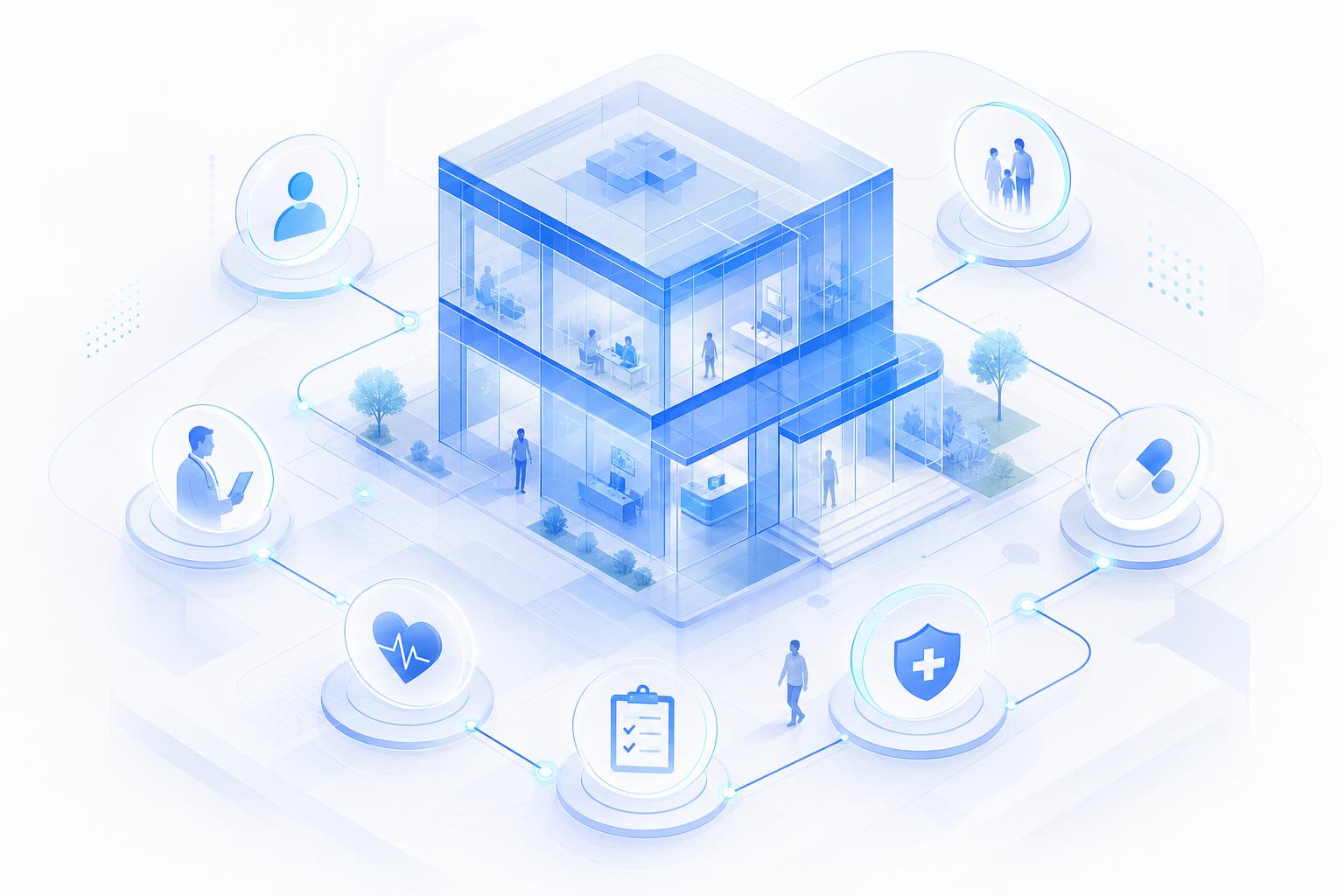
Layered illustration of a glass medical clinic surrounded by patient-journey nodes connected by glowing pathways

30-day

Production install

+38%

Qualified patient leads

−31%

Cost per acquisition

24/7

AI receptionist coverage

Patient acquisition is no longer a marketing problem but an infrastructure problem. A modern healthcare practice runs on at least a dozen disconnected vendors, such as a website agency, an SEO contractor, a media buyer, a paid social freelancer, a call-tracking tool, a scheduling platform, an EHR, and a reputation tool. Most offices then have a back-office that tries to stitch it all together with spreadsheets. Every handoff between those systems leaks revenue, whether through a missed call, an unanswered form, a mis-attributed conversion, or a manual data export that nobody owns.

Rocklane builds the integrated alternative. We install one accountable revenue infrastructure across your entire patient journey, spanning from the first impression on a paid ad through the closed treatment plan. We then overlay it with a revenue intelligence layer that ties every dollar of spend to produced patient revenue. The website, the ad accounts, the AI receptionist, the reporting, and the optimization cadence all live under one engagement and one dashboard. This approach makes growth predictable instead of episodic.

This page explains how the infrastructure works specifically for healthcare. We cover the architecture, the AI intake layer, the attribution model, the compliance posture, and what you can expect from a 30-day production install for clinics, multi-location groups, and dental service organizations.

What's included

Our service provides a complete capability set from day one.

HIPAA-aware data handling and minimum-necessary intake architecture

Service-line-level tracking from impression to closed revenue

AI receptionist that books qualified appointments in under 30 seconds, 24/7

Reputation, recall, and referral loops engineered into the funnel

Multi-location reporting with provider- and chair-level attribution

Custom integrations with EHR, PMS, and scheduling platforms

Patient acquisition campaigns across Google, Meta, and local placements

Conversion-optimized service-line landing pages, refreshed quarterly

Lead qualification, scoring, and triage powered by language models

Weekly executive digest and quarterly business review with the operating partner

01 / 06

Why healthcare buyers behave differently and why generic agencies miss it.

A patient choosing a dermatologist or a parent choosing a pediatric dentist is not behaving like a typical online shopper. The decision is high-consideration, locally constrained, often urgent, and frequently driven by insurance, referral, or reputation rather than pure value comparison. Healthcare keywords cost more, qualified leads are scarcer, and the cost of a missed call is measured in lost lifetime patient value instead of a single conversion.

Generic agencies optimize for the metrics they can see, such as cost per click, cost per lead, and form fills. The actual leverage in healthcare lives upstream and downstream of those numbers. Success depends on knowing which service lines have capacity, which providers convert best, which calls came from which campaign, and which patients booked, kept, paid, and rebooked. Without that loop closed, you are essentially flying in the dark.

Rocklane instruments the full loop. We tie campaign spend to scheduled appointments, kept appointments, and produced revenue at the provider and service-line level. That tells you not just whether marketing worked, but where to allocate the next dollar.

See how the patient acquisition system works

02 / 06

The integrated revenue infrastructure through one architecture and six layers.

Most healthcare growth stacks fail because they were assembled rather than designed. Rocklane engineers the infrastructure as a single product with six tightly coupled layers. Each is accountable for a defined revenue contribution and feeds the same intelligence layer.

  • Layer 1. Acquisition surface.

    AI-powered websites, service-line landing pages, and local pages built for conversion and instrumented from the start. Every page renders fast, ranks well, and ships with structured data baked in.

  • Layer 2. Demand generation.

    Paid search, paid social, and local placements operated against a service-line capacity plan rather than a flat lead target. Spend follows the chairs and providers that need to be filled.

  • Layer 3. AI intake.

    A 24/7 AI receptionist that answers calls, qualifies the inquiry, books directly into your scheduling system, and triages anything outside its scope to a human within seconds.

  • Layer 4. Lead qualification.

    Language-model scoring on every inbound lead from calls, forms, and chat with reasoning attached. This ensures the front desk knows which patient to call back first.

  • Layer 5. Attribution and reporting.

    First-click to closed-revenue attribution at the provider, service-line, and location level, all surfaced in the executive dashboard and a weekly digest.

  • Layer 6. Compounding loops.

    Reputation collection, recall sequences, and referral mechanics engineered into the post-visit experience so each acquired patient yields more than one cycle of revenue.

03 / 06

AI intake is the highest-leverage automation for a healthcare practice.

Industry data is consistent and clear. Roughly 30 to 40 percent of inbound calls to a typical multi-location practice go unanswered or roll to voicemail, and the majority of those callers do not call back. At a high patient lifetime value, that is an expensive line item on your P&L that remains invisible because it never enters a CRM.

Rocklane deploys a voice-and-chat AI receptionist trained on your service lines, providers, insurance posture, scheduling rules, and tone. It answers every call within two rings, qualifies the patient, and books the appointment in your scheduling system. It only escalates to a human when policy or sensitivity requires it. This typically results in a 20 to 35 percent lift in booked appointments from the same acquisition spend because the leak at the bottom of the funnel is closed.

We do not bolt the receptionist onto your stack as a separate vendor. It is wired directly into the website forms, the call-tracking number, the AI lead qualifier, and the reporting dashboard. This ensures attribution stays clean and front-desk staff get a single triaged queue instead of a separate inbox.

How the AI intake automation works

04 / 06

Attribution that withstands executive review.

If your current reporting cannot determine which service lines made money and what they cost to acquire, you are not measuring marketing effectively. Rocklane installs a closed-loop attribution model that ties every dollar of paid spend to a scheduled appointment, a kept appointment, a treatment plan, and produced revenue at the service-line and provider level.

The model is designed for strict review. Channel-level traffic and lead numbers are reconciled against call-tracked conversations and CRM-recorded revenue, with discrepancies flagged automatically. We do not rely on platform-reported conversions in isolation because those are a sanity check rather than the source of truth.

Multi-location groups get rolled-up board views, per-location operator views, and per-provider productivity views. The reporting layer is a primary deliverable and much more than a screenshot in a deck.

See the analytics & reporting layer

05 / 06

A compliance posture focused on actual security.

Healthcare marketing technology is complex. Many of the tools practices use today are not designed for PHI. Ad pixels might send identifiable data to platforms with no BAA, and scheduling tools often sync demographics into marketing automations. Most practices learn about these risks only after a breach or legal action.

Rocklane designs intake, analytics, and ad infrastructure with minimum-necessary data capture as the default. We do not pipe PHI to ad pixels and we sign BAAs where data processors require them. We segment which systems hold identifiable patient data and which hold aggregate marketing analytics. We then enforce the boundary with access controls and data export rules.

While your compliance team owns the final review, our architecture is built so that compliance functions as a configuration rather than a renovation.

06 / 06

Built for clinics, multi-location groups, and DSOs.

Single-location specialty clinics use Rocklane to consolidate multiple point vendors into one accountable team. Multi-location groups use it to install a consistent acquisition motion across markets while preserving local operator nuance. DSOs and multi-state groups use it for the reporting layer where provider-level and chair-level attribution becomes a dashboard tool for the board.

The same operating system scales across all three. The primary change is the engagement shape. A single-location practice typically buys discrete systems like the AI website, the patient acquisition campaigns, or the AI intake on a fixed basis. Multi-location and DSO clients move into a custom revenue-system contract with quarterly executive reviews tied to specific targets.

Browse the full healthcare service catalog

Frequently asked

Common questions from buyers.

Do you only work with healthcare brands?
Yes. Healthcare is the only category we serve, including multi-location dental groups, DSOs, plastic surgery, dermatology, med spa, mental health, specialty practices, and concierge medicine. We deliberately do not take work outside healthcare so the team, playbooks, AI intake training, and attribution model stay tuned to a single buying journey.
How is Rocklane different from a marketing agency or a fractional CMO?
Agencies sell channels while fractional CMOs sell strategy decks. We install a working revenue system featuring websites, ad accounts, AI intake, attribution, and reporting. These are operated as one integrated stack with a single accountable team and a shared revenue dashboard. You get strategy, execution, and infrastructure under one engagement.
What does a 30-day install actually look like?
During Week 1, we focus on diagnostic work, baseline metrics, and attribution wiring. Week 2 involves the site rebuild and intake automation in staging. In Week 3, we take paid media accounts, tracking, creative, and the AI receptionist live in test traffic. Week 4 marks the production launch, executive handoff, and the start of weekly optimization sprints.
Can you integrate with our EHR or practice management system?
Yes. We have shipped intake, scheduling, and reporting integrations with the major dental, medical, and aesthetic platforms. When a direct integration does not exist, we use webhook bridges and append-only export pipelines so revenue attribution still ties back to closed appointments without exposing PHI to marketing tools.
How do you handle HIPAA and patient data?
We design intake and analytics with a HIPAA-aware architecture using minimum-necessary data capture, no PHI in ad pixels, signed BAAs where required, and access controls scoped per provider and per location. Marketing analytics stay aggregate while identifiable patient records stay inside your systems.
What does pricing look like for a multi-location practice?
Engagements scale with locations and service-line complexity rather than headcount. A single-location specialty practice typically engages on a per-module basis. For example, the AI Website is $4,500 setup plus $295/mo, AI Intake is $1,500 setup plus $695/mo per location, and the Reputation Engine is $750 setup plus $395/mo per location. Multi-location groups move to a bundled tier engagement starting at $4,950/mo for Growth or $9,950/mo for Scale. DSOs and multi-state platforms move to Platform starting at $22,500/mo or Enterprise starting at $48,000/mo, which include quarterly executive reviews and provider-level attribution.

Related revenue systems

Keep exploring the infrastructure.

Ready to engineer the next quarter of revenue?

Book a 30 minute strategy call so we can map your funnel, identify the highest leverage system, and ship within 30 days.